

Details
Product Details
- Average Rating:
- 149
- Faculty:
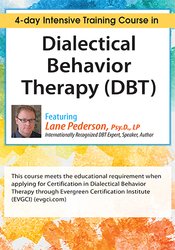
- Lane Pederson, PsyD, LP, C-DBT
- Duration:
- 23 Hours 19 Minutes
- Copyright:
-
11 Sep, 2018
- Product Code:
- RNV044810
- Media Type:
- DVD
- Access:
- Never expires.
CPD
Handouts
| File type | File name | Number of pages | |
|---|---|---|---|
| Manual - Dialectical Behavior Therapy (DBT) (2.18 MB) | 88 Pages | Available after Purchase | |
| Extras Handouts (0.35 MB) | 96 Pages | Available after Purchase |
Faculty

Lane Pederson, PsyD, LP, C-DBT Related seminars and products
Lane Pederson, PsyD, LP, C-DBT, has provided Dialectical Behavior Therapy (DBT) training and consultation to over 30,000 professionals in the United States, Australia, South Africa, England, Canada, Mexico, and the Middle East through his training and consultation company, Lane Pederson and Associates, LLC (www.DrLanePederson.com). A real world practitioner, Dr. Pederson co-owns Mental Health Systems, PC (MHS), one of the largest DBT-specialized practices in the United States with four clinic locations in Minnesota (www.mhs-dbt.com). At MHS, Dr. Pederson has developed DBT programs for adolescents, adults, people with dual disorders, and people with developmental disabilities. He has served as clinical and training directors, has directed practice-based clinical outcome studies, and has overseen the care of thousands of clients in need of intensive outpatient services.
Dr. Pederson’s DBT publications include The Expanded Dialectical Behavior Therapy Skills Training Manual, 2nd Edition: DBT for Self-Help and Individual & Group Treatment Settings (PESI, 2017); Dialectical Behavior Therapy: A Contemporary Guide for Practitioners (Wiley, 2015); Dialectical Behavior Therapy Skills Training for Integrated Dual Disorder Treatment Settings (PESI, 2013) and The DBT Deck for Clients and Therapists: 101 Mindful Practices to Manage Distress, Regulate Emotions & Build Better Relationships (PESI, 2019).
Notable organizations he has trained for include Walter Reed National Military Hospital, the Federal Bureau of Prisons, the Ontario Psychological Association, the Omid Foundation, and Psychotherapy Networker. He has provided DBT training for community mental health agencies, chemical dependency treatment centers, hospital and residential care settings, and to therapists in forensic settings. Dr. Pederson also co-owns Acacia Therapy and Health Training (www.AcaciaTraining.co.za) in South Africa. Dr. Pederson currently serves on the advisory board for the doctorial counseling program at Saint Mary’s University of Minnesota and is a peer reviewer for Forensic Scholars Today.
Speaker Disclosures:
Financial: Lane Pederson maintains private practice and is the founder and CEO of Dialectical Behavior Therapy National Certification and Accreditation Association. He receives compensation as a national speaker and receives royalties as a published author. Lane Pederson receives a speaking honorarium, recording, and book royalties from Psychotherapy Networker and PESI, Inc. He has no relevant financial relationships with ineligible organizations.
Non-financial: Lane Pederson serves as an advisory board member to St. Mary's University Doctoral Program in Clinical Psychology.
Lane Pederson is not affiliated or associated with Marsha M. Linehan, PhD, ABPP, or her organization.

Additional Info
Program Information
Access for Self-Study (Non-Interactive)Access never expires for this product.
Objectives
- Discriminate DBT from the contextual model of therapy.
- Evaluate DBT research in light of the contextual model and the Evidence-Based Practice of Psychology (EBPP).
- Correlate DBT philosophies and interventions to the therapeutic factors that most improve outcomes.
- Explore dialectic philosophies and their application in therapy.
- Determine how the core assumptions of DBT are put into action in therapy.
- Assess how DBT theory drives therapeutic interventions.
- Communicate how to balance validation and change strategies in clinical situations.
- Integrate mindfulness techniques into therapy
- Implement an effective therapy structure that includes identifying clear treatment goals.
- Practice how to effectively teach the four standard DBT skills modules - mindfulness, emotion regulation, distres tolerance and interpersonal effectiveness.
- Design teaching strategies for skills training sessions.
- Plan and teach supplemental DBT skills and modules.
- Practice DBT skills training techniques in small groups.
- Recommend how to seamlessly integrate DBT skills into individual therapy.
- Discriminate the DBT model from cognitive-behavioral, client-centered, and other treatment modalities.
- Practice a multi-layered approach to validation of clients' thoughts and feelings.
- Establish balance validation with the most effective (and practical) methods of behavior change.
- Practice reciprocal and irreverent communication styles, to be utilized within the therapy session.
- Comment on the key differences between traditional cognitive interventions and DBT-style cognitive interventions.
- Practice therapy techniques with effective pacing, balance, and flow.
- Articulate when to use (and not to use) exposure techniques.
- Employ DBT diary cards and chain (change) analysis.
- Propose how to operate with consultative groups and treatment teams.
- Assess and manage self-injurious and suicidal behaviors with clear protocols and safety plans.
- Establish clear plans for crisis management, including psychiatric hospitalizations.
Outline
Foundations of DBT- The Story of DBT
- Explicit focus on validation
- Cognitive-behavioral change strategies
- Skills training
- Consultative approach
- Mindfulness
- Dialectical balance
- Five functions of DBT
- Is it DBT?: What’s needed in a DBT clinical process
- Dialectics explained
- Dialectical assumptions
- Dialectics in action
- Dialectical Abstinence. When NOT to be dialectical
- Acceptance and nonjudgmental stance
- View of clients, therapist and therapy
- DBT Modes and Formats
- DBT Research: Understanding and Context
- Evidence-Based Practice versus
- Evidence-Based Treatments
- Understanding how therapy works
- Six decades of empirical research
- Maximizing therapeutic factors, DBT-style
- Biosocial theory of difficulties
- How theory drives therapy
- Update to Theory: RO DBT
- Structure as a therapeutic factor
- Structuring the environment
- DBT Stages
- Identifying treatment targets: suicidality, self-injurious behavior (SIB), therapy-interfering behavior (TIB), and other targets
- Children and Adolescents
- Substance Use Disorders
- Levels of Care
- Mindfulness explained
- Mindfulness of the approach
- Mindfulness as a therapy technique
- Mindfulness in life
- Integrating skills into therapy
- Using skills to develop new behaviors
- Methods for skills training
- What skills: observe describe, participate
- How skills: nonjudgmental, one-mindful, effectively
- Mindfulness practice and application
- Identify dialectical dilemmas
- Activate Wise Mind action
- For adolescents and parents: Middle path
- For substance use disorders: dialectical abstinence
- Wise mind ACCEPTS
- IMPROVE the moment
- Pros and cons
- Radical acceptance/turning the mind
- Model of emotions
- PLEASED
- Build positive experiences
- Opposite action
- FAST skills
- GIVE skills
- DEAR MAN skills
- Urge surfing
- Bridge burning
- TIP
- DBT Clinical Process
- Standard
- Adapted for special populations
- Getting the client on board
- Build awareness and options
- Bridging into solution analysis
- A multi-layered approach
- As an exposure technique
- Used dialectically with change
- Difference from normalization
- Behavioral principals
- Contingency procedures
- Best behavior change methods
- DBT-style cognitive interventions
- When to use (and not to use)
- Exposure protocols
- Alternatives to exposure
- Reciprocal
- Irreverent
- Increase your motivation
- Develop effective responses
- Qualities of effective treatment teams
- When is SIB life-threatening?
- Creating alternatives
- Suicide assessment techniques
- Establishing safety protocols
- Safety plans and safety commitments
- Effective use of the hospital
- Transitions in and out
- What you learned and what you need
- Developing your plan
- Taking action
Please Note: Lane Pederson, PsyD, LP is not affiliated or associated with Marsha M. Linehan, PhD, ABPP, or her organizations.
Target Audience
- Counselors
- Psychologists
- Psychotherapists
- Psychiatrists
- Social Workers
- Marriage & Family Therapists
- Addiction Counselors
- Case Managers
- Mental Health Professionals
- Nurses
Reviews
| 5 |
|
| 4 |
|
| 3 |
|
| 2 |
|
| 1 |
|
Overall: 4.8
Total Reviews: 149
Satisfaction Guarantee
Your satisfaction is our goal and our guarantee. Concerns should be addressed to: PO Box 1000, Eau Claire, WI 54702-1000 or email info@pesi.com.au.
Please wait ...