

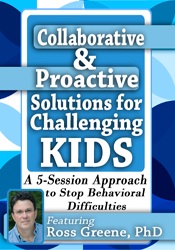
Collaborative & Proactive Solutions for Challenging Kids: A 5-Session Approach to Stop Behavioral Difficulties
Details
Product Details
- Average Rating:
- 10
- Faculty:
- Ross Greene, Ph.D.
- Duration:
- 7 Hours 10 Minutes
- Copyright:
-
01 Jun, 2016
- Publisher:
- PESI Inc.
- Product Code:
- RNV049010
- Media Type:
- DVD
- Access:
- Never expires.
CPD
Faculty
Ross Greene, Ph.D. Related seminars and products
Ross W. Greene, Ph.D., is Associate Clinical Professor in the Department of Psychiatry at Harvard Medical School and the originator of a model of psychosocial treatment for challenging kids called Collaborative Problem Solving (CPS). He is author of the highly-acclaimed books The Explosive Child and Lost at School and has also authored numerous articles, chapters and scientific papers on the effectiveness of the CPS model, the classification of and outcomes in youth with social, emotional and behavioral challenges and student-teacher compatibility. Dr. Greene's research has been funded by, among others, the Stanley Research Institute, the National Institute on Drug Abuse/National Institutes of Mental Health, the U.S. Department of Education and the Maine Juvenile Justice Advisory Group. He consults extensively to general and special education schools, inpatient and residential facilities and systems of juvenile detention, and lectures widely throughout the world.
Additional Info
Program Information
Access for Self-Study (Non-Interactive)Access never expires for this product.
Objectives
- Characterize the main difference between the classical therapeutic approach to treating a child’s challenging behavior and the Collaborative & Proactive Solutions (CPS) approach to solving the same issue.
- Assess what a child is communicating when he/she displays challenging behavior.
- Articulate the clinician’s approach to treating a child’s challenging behavior within the CPS Model.
- Present the five types of sessions in the CPS Model and how the role of the clinician changes for each of the five types.
- Characterize the ALSUP form and indicate how the clinician uses it to ascertain the child’s lagging skills and unsolved problems.
- Articulate the positives and negatives of all three approaches to handling an unsolved problem: Plan A, Plan B and Plan C.
- Articulate how to involve the parent(s)/caregiver(s) AND the child in the collaborative approach (Plan B).
- Breakdown the three steps to the Plan B approach.
- Articulate how the clinician can teach the parent(s)/caregiver(s) to ‘drill’ for more information from the child during the Empathy Step of the Plan B approach.
- Provide sample wording for the Invitation Step of the Plan B approach.
- Communicate the importance of making sure that the unsolved problem(s) chosen for use in Plan B are specific, realistic and mutually acceptable to all parties involved.
Outline
Collaborative and Proactive Solutions Model
- Types of Sessions
- Investigator
- Instructor
- empathy
- define adult concerns
- invitation to a mutually satisfactory solution
- Demonstrator
- Coach
- Interference factors
Keys to Complete CPS Sessions
- Assessment of Lagging Skills and Unsolved Problems (Investigator Session)
- Strategies to turn the ALSUP form into a ‘discussion guide’, not a ‘checklist’
- Tools to identify a specific lagging skill
- Guidelines to name the unsolved problems
- The unsolved problem should contain NO challenging behavior - replaced by the word “difficulty”
- The unsolved problem contains no ‘adult theories’ as to the cause of the problem
- The unsolved problem is split, not clumped make it much easier for the child to talk about unsolved problems.
- Make sure the unsolved problem is as specific as possible:
- Ask “W” questions: Who, What, Where, When (not Why)
- Ask parents what specific expectation the child is having difficulty meeting in the scenario they are describing
- In-Session Demonstration Videos: ALSUP Sessions
- Clinician/Parent Meeting (Instructor Session)
- Three approaches to handling an unsolved problem
- Plan A: Adult decides the solution
- Plan B: Adult and child collaborate to solve the problem
- Empathy step
- Define adult concerns step
- Invitation step
- Plan C: Unsolved problem prioritization
- Clinician, Parent and Child Meeting (Demonstrator Session )
- Strategies to:
- Overcome competing solutions
- Identify when too many solutions and/or concerns are on the table
- Propose solutions that are realistic and satisfactory to all parties
- Foresee proposed solutions that will fail, and why
- Follow-Up Sessions (Coaching & Interference Sessions)
- As the problem-solving facilitator, the clinician should aim to:
- Keep the session structured
- Keep the family focused on the unsolved problem
- Help the family stay on track
- Identify what part of the plan is difficult and coach the proper skills some more
- Troubleshoot other parts of the plan until the family achieves success - then move on to another high-priority unsolved problem
- Help the family become self-sufficient in carrying out the plan for future unsolved problems
Target Audience
Addiction Counselors, Counselors, Marriage and Family Therapists, Psychologists, Social WorkersReviews
| 5 |
|
| 4 |
|
| 3 |
|
| 2 |
|
| 1 |
|
Overall: 5
Total Reviews: 10
Satisfaction Guarantee
Your satisfaction is our goal and our guarantee. Concerns should be addressed to: PO Box 1000, Eau Claire, WI 54702-1000 or email info@pesi.com.au.
Please wait ...